

The U.S. Army Corps of Engineers has backed out of studying a solution to the glacial outburst floods that have ravaged Juneau’s Mendenhall Valley neighborhoods in recent years.
City officials say the corp’s abrupt change in position comes as a shock, and could derail the city’s timeline to get a long-term solution in place as soon as possible.
Juneau’s City Manager Katie Koester shared the news at a Juneau Assembly committee of the whole meeting Monday night. She called the army corps’ change of position deeply frustrating.
“It was a really disheartening pivot that left us a little bit speechless, and I imagine also leaves you speechless,” she told Assembly members.
The Army Corps has played a critical role in finding short and long-term solutions as the capital city faced catastrophic annual glacial outburst flooding that damaged hundreds of properties and threatened residents’ safety in recent years.
Late last year, the agency held a three-day, closed-door meeting with federal and local agencies in Juneau, where they discussed five long-term options to prevent homes from flooding and ultimately picked one. The solution they landed on was to construct a lake tap, which is basically a tunnel through a mountain by the glacier that would steadily drain Suicide Basin so it doesn’t burst.
Shortly after the Army Corps announced its recommendation, city leaders, along with the U.S. Forest Service and the Central Council of the Tlingit and Haida Indian Tribes of Alaska, all announced their support for pursuing the solution.
But Koester said the plan is in limbo following a meeting with the agency last week.
“They rescinded all of the direction that they’d previously given to pursue a lake tap as the selected alternative, and basically said that they would continue to support flood fighting in the area for an undetermined amount of time,” she said.
Koester said she is still trying to piece together the “why” behind the corps actions, and how it will impact developing a long-term solution.
“We don’t know — we don’t understand why (they made) this change,” she said. “Certainly, the price tag is sobering.”
The lake tap was estimated to cost $613 million to complete. Koester asked residents to reach out to Alaska’s congressional delegation to advocate for moving forward with the lake tap solution.
“This community needs to be very singularly focused and together on what we need and demand for the survival of our community,” she said.
The Army Corps of Engineers has not responded to KTOO’s request for comment.
Koester’s news came shortly after city engineers gave a presentation that shared more information about what they say is a “sobering” outlook for what could be in store in a worst-case scenario for future floods.
“It is massive,” said Denise Koch, the city’s director of Engineering and Public Works.
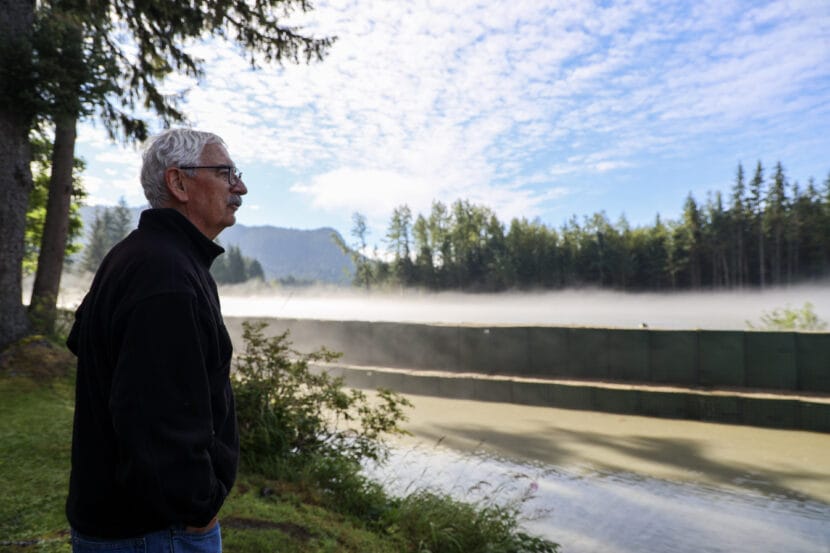
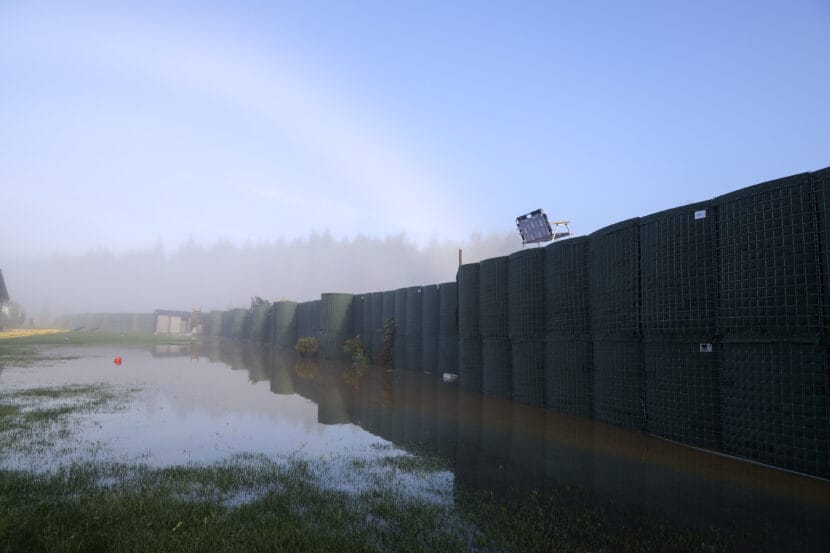
Over the past three years, glacial outburst flooding has crested between 15 and 16.65 feet in the Mendenhall River. Two years ago, more than 300 homes were flooded. Last year, a temporary levee made of HESCO barriers protected hundreds of homes by a slim margin. The city does not know how the levee will perform if flood levels exceed 18 feet.
Koch said new worst-case scenario data shows waters peaking at 22.5 feet with 118,000 cubic feet per second of water.
“Two thousand, eight hundred and fifty-five properties — that’s the magnitude of what could be impacted by that worst-case scenario GLOF,” she said. “It’s hard to almost get your head around how many properties we’re talking about impacting.”
Koch said a worst-case flood would submerge most of the Mendenhall Valley if there isn’t a way to stop the water.
“We’re talking about water crossing over Riverside Drive, moving east into the Valley, crossing over Mendenhall Loop Road, getting into the Dredge Lakes area,” she said. “Also having impacts on the western side of the river, impacting the Mendenhall Wastewater Treatment Plant, having impacts to the airport.”
Koch said the flood tap solution is the best solution to protect residents and properties in the Mendenhall Valley in the long term.
“It has a very high likelihood of reducing that GLOF risk,” she said.
City officials say the Army Corps will still pay for the installation of a second phase of HESCO barriers ahead of this year’s expected flood. Koester said she will be meeting with the agency this week to learn more about next steps. She said the collaboration with the Corps is critical for the future of flood fighting.
Correction: The total estimated cost for the Army Corp’s proposed lake tap solution was $613 million.
Copyright 2026 KTOO